

You’re Using Comments Wrong. Here’s What 51% of You Are Actually Doing Instead.
Engagement isn’t the same as strategy.

You’ve heard the rule.
Engage with 10 posts before publishing your own. Comment consistently. Show up every day. Leave your mark across the platform and eventually, through some mysterious law of internet karma, the readers will come to you.
So you do it.
You open Substack, scroll your feed, leave a few replies, maybe share your latest article in someone’s comment section, and check the box. Engaged. Done. Time to post.
And then you refresh your stats 45 minutes later and nothing moved.
So you engage more. You reply to more posts. You follow more writers. You spend an entire Tuesday morning doing “community building” and gain two subscribers, one of whom unsubscribes by Friday (probably your mom testing the system).
Here’s what I realized after running a growth assessment with 85 frustrated writers:
51% of respondents said they use comments to drive traffic to their newsletter.
When I dug deeper into what they were actually doing?
Most of them were commenting the same way I just described.
Showing up. Checking the box. Engaging without a strategy.
And wondering why it felt like shouting into a very polite, supportive void.
Comments aren’t broken. The way most writers use them is.
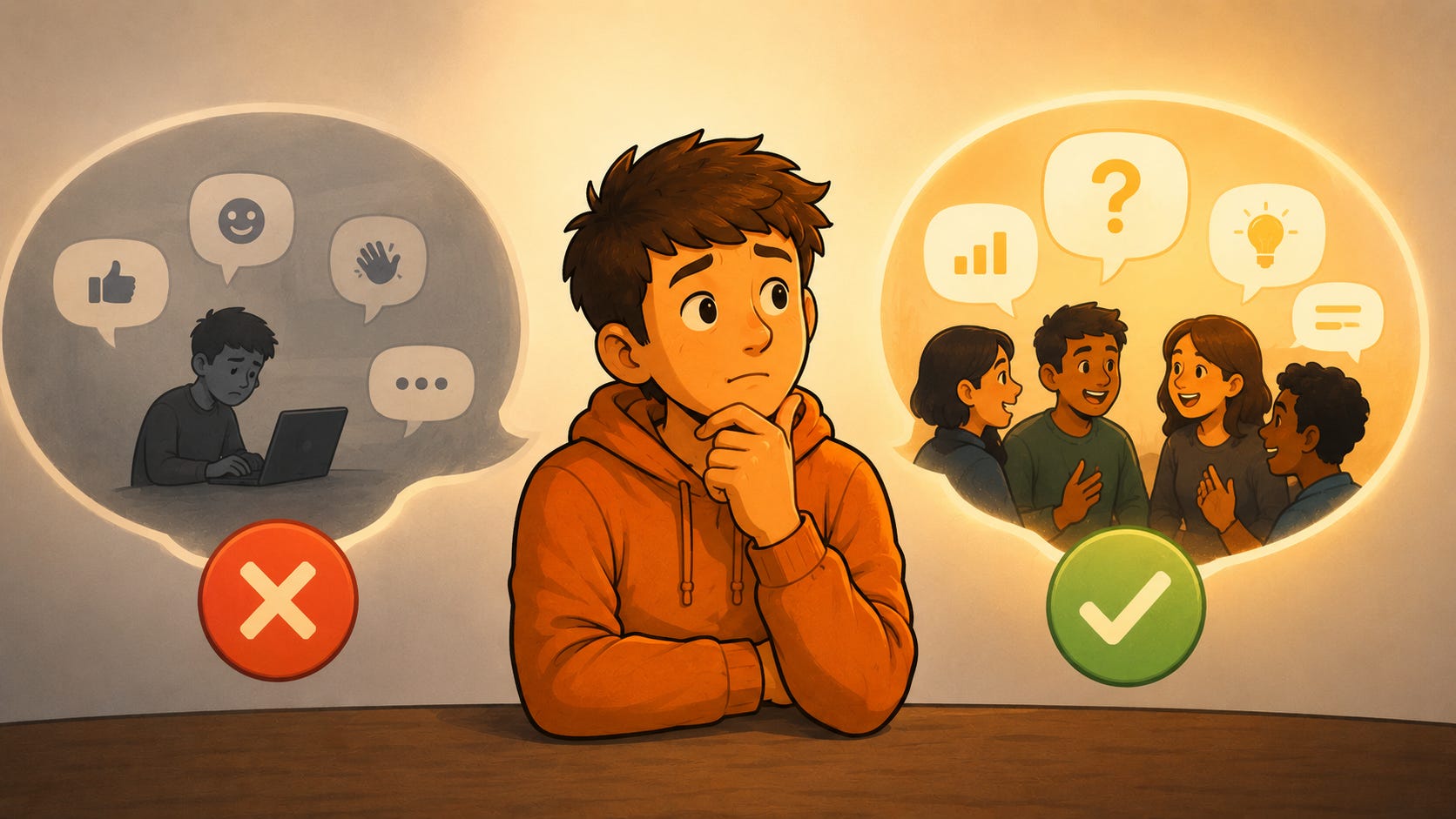
What “Commenting for Growth” Actually Looks Like (For Most People)
There are three comment behaviors I see constantly. All of them feel productive. None of them do what people think they do.
The Cheerleader Comment. “This is so good!! Really needed this today 🙌”
Warm. Nice. Completely forgettable. The author appreciates it for 4 seconds and moves on. Nobody clicks your profile. Nobody remembers your name. You are a thumbs up with a bio attached.
The Self-Promoter Comment. “Great post! I actually wrote something similar about this, [link to your article]”
I’ll be honest with you: this one makes people quietly annoyed. You took someone else’s post and turned it into a billboard for your own content. Even if your article is genuinely relevant, the move feels extractive. And people on Substack notice extractive immediately, it’s a platform built on trust, and trust has a very low tolerance for that kind of thing.
The 10-Before-Posting Comment. This is the most dangerous one because it actually sounds like a strategy.
Engage with 10 posts before publishing your own to warm up the algorithm. So you go through your feed, leave 10 generic but reasonably thoughtful replies, publish your article, and... the algorithm barely notices. Because what you just did wasn’t engagement. It was pre-flight prep for a plane that wasn’t ready to fly.
The algorithm doesn’t reward volume of comments. It rewards quality of interactions, replies, reshares, conversations that continue. Ten “nice post!” comments are not that.
Here’s the thing none of this is your fault. Nobody actually told you what comments are for.
Hey! If you don’t know me, I’m William, a 20-year-old creator who spent months posting into the void before figuring out how to actually grow on Substack 😅
Since then, I’ve grown my newsletter to 1,500+ subscribers, helped 40+ writers improve their growth, built the Growth Lab community, and tested hundreds of growth experiments while juggling school, work, training, and content creation at the same time.
Now I’m documenting everything I’m learning so you can grow faster without wasting months figuring it out alone.
Every Monday, I break down big Substack creators and why they grow. Every Wednesday, I share a practical growth article. And every Friday, we have real conversations inside the community. Subscribe and build with us 🤝

What Comments Are Actually For
This reframe changed everything for me.
Comments are not a distribution channel.
They’re a research lab.
Every comment you leave in the right place, on the right post, in the right niche, with the right question, gives you information that no analytics dashboard can give you. You learn what that community actually cares about. What language they use. What frustrates them. What they’re trying to do.
That information is worth more than any growth tactic.
Because the writers who know their audience at that level of depth don’t have to guess what to write next. They don’t have to wonder why their articles aren’t converting. They don’t have to keep testing hooks like scientists running experiments with no hypothesis.
They already know.
And they got there through comments.
Here’s what a comment that actually does something looks like:
Add value first: “I totally agree with your point about…”
Explain why: “I’ve noticed the same thing with my own workflow. Every time I remove distractions before work, I get twice as much done.”
Then ask a question that helps you identify whether they’re a potential reader: “Curious, are you writing for busy parents juggling work and kids, or more for people who have flexible schedules and just want to become more productive?”
Finally, end by opening the door to a relationship: “Would love to connect and keep following your writing!”
Example (on a productivity writer’s post aimed at adults with a 9-to-5 and kids):
“I completely agree that people underestimate how exhausting decision fatigue is after a full workday. I started planning my next day the night before, and it’s made a huge difference. Curious, do you mostly write for parents balancing work and family, or for anyone trying to become more productive? I’d love to connect and keep reading your work!”
It adds a real perspective. Not validation, a genuine extension of the thought. Maybe you agree but from a completely different angle. Maybe you push back on one sentence while agreeing with the rest. Maybe you share a result from your own experience that makes the author’s point more concrete.
And then, this is the part most people skip, it ends with a question.
Not a rhetorical question. A real one. Something you’re actually curious about. Something the author or another commenter would want to answer.
That question is what starts a conversation. And conversations are what make people click your name, read your bio, and decide you’re worth following.
One good question at the end of a thoughtful comment does more for your visibility than 20 cheerleader replies.
The Real Strategy: Comments as Intel, Not Promo
Here’s how to use comments the way the fastest-growing writers on Substack actually use them.
Find the 3 to 5 writers in your niche with the most engaged comment sections, not the most subscribers, the most engaged comments. Those comment sections are a live focus group for your exact audience. Read what people are saying. What questions are they asking? What problems keep coming up? What language do they use to describe their frustration?
Write it down. Literally. That’s your next 10 article ideas.
Comment with curiosity, not credentials. The goal isn’t to prove you know things. It’s to find out what the people in that comment section care about. Ask questions. Respond to other commenters, not just the author. Start threads.
When someone replies to your comment with something real, follow up in DMs. Not with a pitch. With a continuation. “Your point about X was interesting, are you working on that problem right now?” That’s how comments turn into relationships, and relationships on Substack turn into recommendations, collaborations, and subscribers who actually stick around.
Use comments to find your best potential readers before they ever see your newsletter. The person leaving the most thoughtful replies in a niche you write about? That’s your reader. They just don’t know it yet. A genuine comment. A real DM. One useful piece of content sent without an ask.
That sequence, comment, DM, resource, is the actual growth engine most people are looking for when they sit down to “engage with 10 posts before posting.”
Same amount of time. Completely different result.
The Honest Part
I’m not going to tell you this is fast.
Building real relationships through comments takes weeks, not hours. You won’t leave 3 thoughtful questions and wake up to 200 new subscribers tomorrow.
But here’s the math that changed how I thought about this:
One genuine comment that starts a real conversation is worth approximately 30 cheerleader comments in terms of actual growth impact. Not because it’s nicer or more virtuous. Because it creates something the other 30 don’t, a reason for someone to learn your name.
And on a platform where most people are commenting to be seen, being the person who comments to listen makes you the most interesting person in the room without saying a single clever thing.
And if you want to figure out which of these issues is actually yours, the volume gap, the positioning problem, or something else, I built a free assessment that tells you exactly where you’re leaking growth. Most writers are surprised by the answer (I was surprised by the data too).
Grab it now!
Takes 3 minutes to complete
Give you a perzonalized roadmap designed to fit your situations
You have the ebst next step to go 10 time faster with actionnable steps
Your Action This Week
Three things. Pick one niche you write about.
Day 1 to 2: Find 3 writers in that niche with active comment sections. Don’t comment yet. Just read the threads. Write down the 5 most common questions, frustrations, or topics that keep coming up. That list is your research.
Day 3 to 5: Leave one real comment per day on posts in your niche. Each comment must add a perspective AND end with a genuine question. No cheerleading. No links to your own work. Just curiosity.
Day 6 to 7: If anyone replied to your comment with something real, send them a DM. Not a pitch. One sentence continuing the conversation.
Do that for one week and track how many real conversations you started vs. how many profile clicks you got on your “engage with 10 before posting” weeks.
The difference will be obvious.
💬 The Writers Who Comment to Listen
This section is for the ones who realized this week that they’ve been leaving comments like flyers on a car windshield, technically reaching people, but making nobody happy about it.
The shift from “commenting for visibility” to “commenting for intel” is quiet. Nobody sees it happen.
But your next 3 collaborations, your next partnership, your next 50 subscribers who actually engage, a lot of them will come from a conversation that started with one good question at the end of one real comment.
You just have to start asking.
Here’s my question for the comments (appropriately):
When you leave a comment on Substack, what’s your actual intention, visibility, connection, or something else? And has it ever led to something real?
Drop it in the comments. Genuinely curious where most of you are at right now.
Thanks everyone for reading BeBetter. If you would like to support, don’t hesitate to restack, share, like and comment.
I really appreciate all kind of support even if it’s just a “this helps”.
Continue the good work!
— William 😁
Connection….
And yes it has because I got to connect and be friends with amazing people that are also helping me grow while I help them as well!
Thank you so much for this article, Always helpful and beneficial! I will definitely try out this strategy!